2023
Mannesmann — Tube Bundle Draining Optimization
Industrial Partnership · Mannesmann Precision Tubes
Photos & Illustrations
Industrial Context
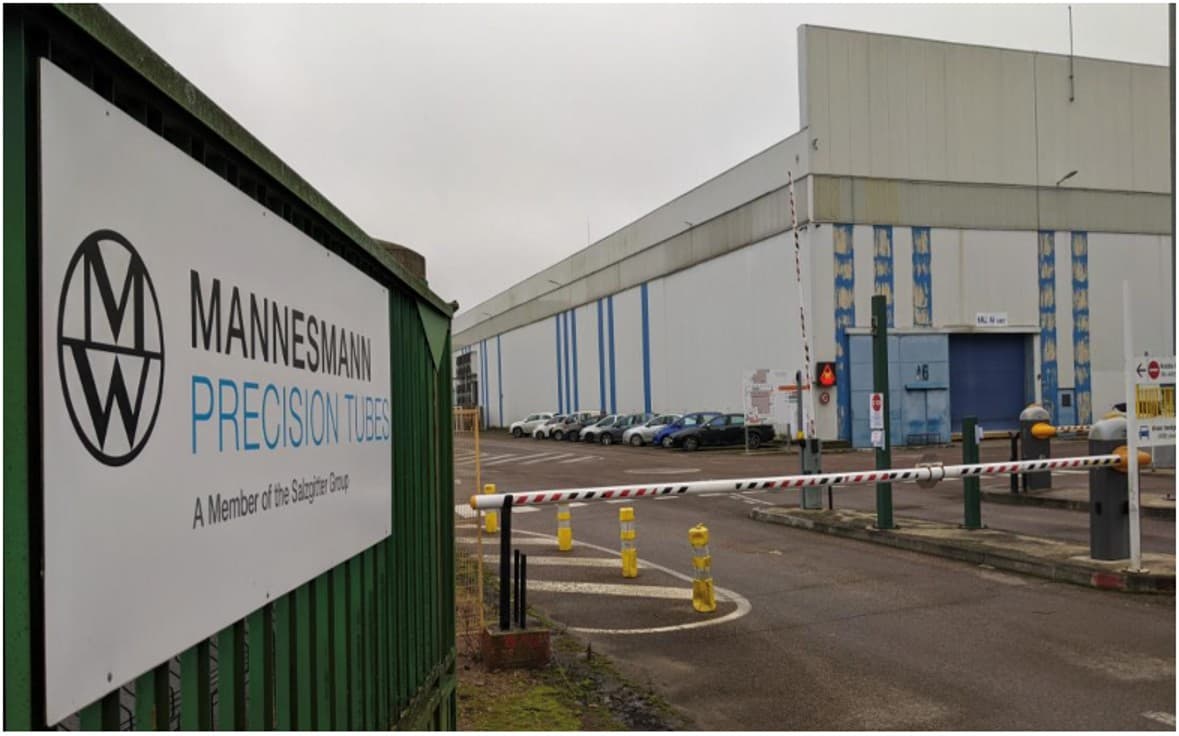
Mannesmann Precision Tubes (a member of the Salzgitter Group) manufactures seamless precision steel tubes used in oil & gas, automotive, and hydraulics. After each oil bath treatment (surface protection), tube bundles must drain completely before packing and shipping.
The current process requires approximately 20 hours of draining at room temperature — a significant bottleneck in production throughput.
The engineering brief: reduce draining time to under 8 hours while keeping the process economically viable.
Factory Visit
The project began with an on-site visit to the Mannesmann plant in Châlons-en-Champagne. We observed the full treatment line: oil bath immersion, extraction, and the existing draining racks. This gave us a direct understanding of the constraints — space, tube bundle geometry, handling equipment, and acceptable process changes.
The Problem: Why Draining Is Slow
Tube bundles are hexagonally packed. When plugs are inserted in both tube ends (as required for the oil bath), residual oil is trapped inside the tube by surface tension and capillary effects. The plug geometry, oil viscosity, inclination angle, and temperature all affect drainage rate.
Two Design Solutions
Solution 1 — Contact Plate (Ajourée)
A plate is added directly against the plug face, cut with apertures (ajours) between plug positions. The plugs remain in relief — their heads protrude through the plate apertures, maintaining a seal. Oil drains through the gaps between plugs via the plate apertures.
Order of assembly: Plate → Plugs (relief) → Tubes
Advantage: simple geometry, standard plugs.
Constraint: requires precise alignment of apertures with plug spacing.
Solution 2 — Spacer Plate
The plate is mounted in retrait (set back) from the tube face on spacers. Plugs are positioned on the spacers, not flush with the plate. This leaves the tube face completely free — oil drains unobstructed from the bath side.
Order of assembly: Plate → Spacers → Plugs → Tubes
Advantage: better draining from the bath side, no obstruction.
Constraint: slightly more complex assembly.
Optimization: Angle and Temperature
Beyond plug design, we modelled the effect of inclination angle and bath temperature on draining time using fluid dynamics approximations (viscosity as a function of temperature, gravity-driven flow in an inclined tube):
| Configuration | Draining time (20m tube) | |---------------|------------------------| | Current: 10°, 15°C | ~20 hours | | Improved: 20°, 30°C | ~10 hours | | Optimal target: 20°, 40°C | ~4.6 hours |
The chart shows that inclination angle has a stronger effect than temperature for the useful range. A modest increase in oil temperature (heated draining bay) combined with a steeper rack angle achieves the target with existing plug systems.
What This Demonstrates
- Reading a real industrial problem and extracting the engineering variables that matter
- Multi-variable optimization under physical and operational constraints
- Design thinking: two different solutions with explicit trade-offs
- Factory-floor grounding: the constraints came from observing the actual process, not a textbook