2023
Pump Body — Cast, Machine, Measure
Arts et Métiers Châlons · Manufacturing Engineering
Photos & Illustrations
Project Overview
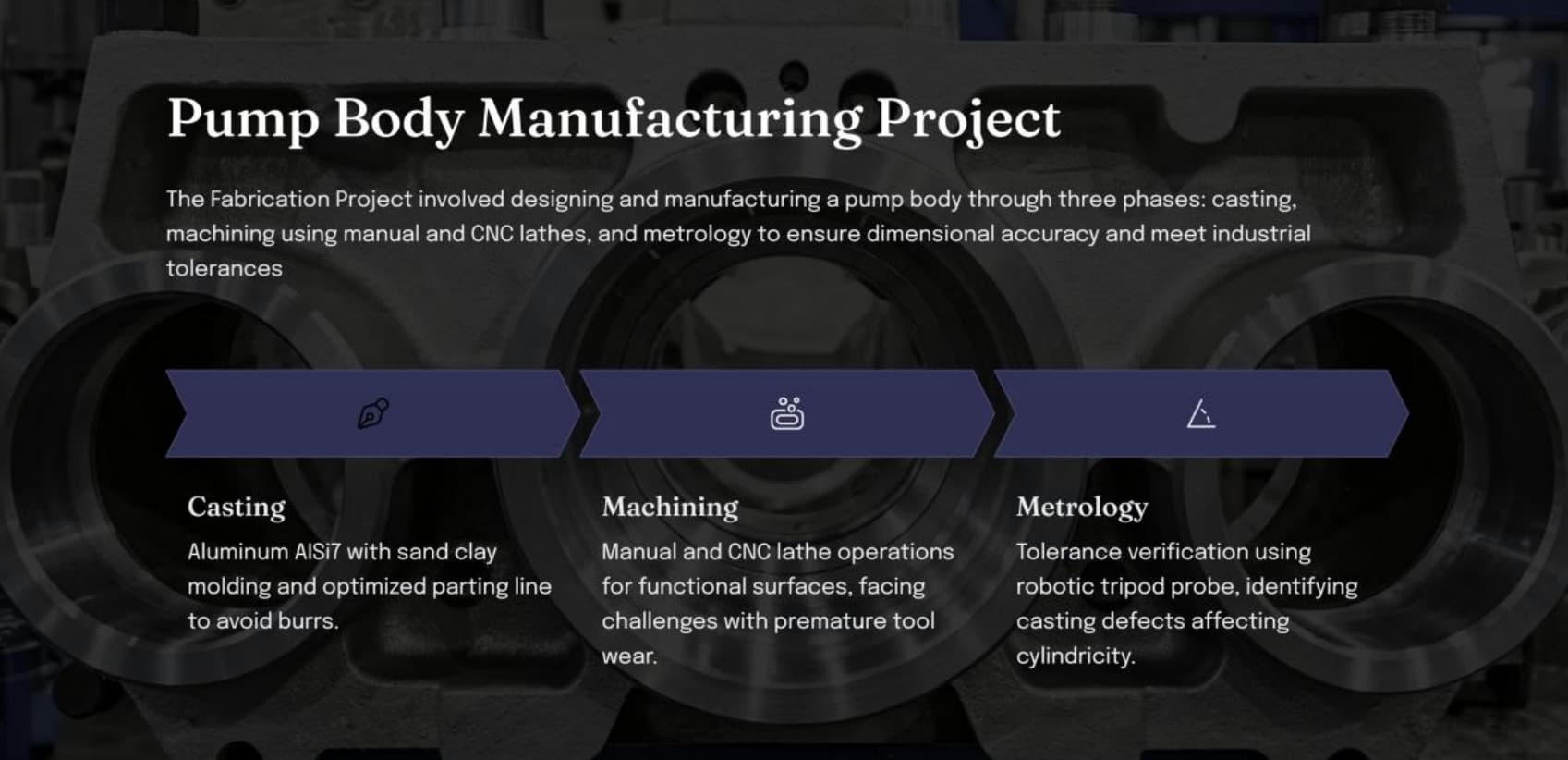
The pump body project covers the complete manufacturing cycle of an aluminium pump body: sand casting, CNC machining, and metrology. Each phase has its own engineering constraints, failure modes, and verification methods.
Phase 1 — Sand Casting (AlSi7)
Material
AlSi7 (aluminium-silicon 7%) was selected for its:
- Good fluidity — high Si content aids mould filling
- Low shrinkage coefficient
- Good machinability after solidification
Mould Design
Key decisions:
- Parting line (plan de joint): positioned to minimise undercuts and allow clean mould separation
- Draft angles (dépouille): 1–3° on all vertical faces for pattern extraction
- Machining allowance (surépaisseur): 2–3 mm on all surfaces to be machined
- Core (noyau): internal cavity formed by a sand core suspended in the mould
- Sprue and vents: feed channel at the heaviest section; vents at cavity top
The raw cast parts showed expected surface roughness (~Ra 12 µm). Some parts exhibited cold shut defects on thin sections — a casting fault with consequences downstream.
Phase 2 — Machining (CNC Turning)
Operations on a Mazak CNC lathe (and manual lathe for preliminary facing):
- Facing — establish datum reference face A
- External turning — outer diameter to tolerance
- Boring — internal bore to H7 (functional fit surface)
- Threading — port connection threads
- Finish turning — Ra ≤ 1.6 µm on functional surfaces
Challenge encountered: premature tool wear on some parts, traced to harder inclusions in the casting from cold shut zones. Cutting parameters were reduced for affected parts.
Phase 3 — Metrology
Dimensional verification with a robotic tripod CMM probe:
- Internal bore: measured at 3 axial positions × 4 angular orientations → cylindricity
- Perpendicularity of bore axis to datum face
- Thread pitch and effective diameter
Finding: two parts showed cylindricity defects outside tolerance, correlated with the casting defects from Phase 1. This closed the feedback loop between casting quality and final dimensional compliance.
What This Demonstrates
This project demonstrates the full manufacturing loop: casting choices affect what happens on the lathe, which affects what the CMM finds. Understanding this chain — rather than treating each phase as independent — is the core of manufacturing engineering.